Project Overview
NEWOIL 3 is a rapid website building system similar to WordPress, designed to enable company clients to quickly have their own website in a short time.
I believe this system heavily relies on industry experience and is the most challenging and rewarding system I've developed.
Project Type: CMS Rapid Website System
Development Time: March 2023
Main Technologies: Laravel, Vue2, Docker
Clients Served: 60+ Enterprise Clients
Supported Languages: 22 Languages
Permission Management: 226 Granular Permissions
Core Design Philosophy
Below I'll use an example to illustrate the core design philosophy of this system.
Hypothetical Scenario
There are 5 clients: A, B, C, D, E
Requirements: Contact Us Form
- Client A
- Name, Phone, Email
- Client B
- Name, Message, Email, Fax
- Client C
- Phone, How did you hear about us, Gender
Development Approach
Initially encountering such problems, the intuitive design is to union all fields and control them through switches. But as the number of clients increases, database fields and switches become more numerous.

Demonstration of different clients' form field requirements
Two Core Concepts
Batch Updates
When there are new features or bugs, update all websites (n clients) at once
Case: Email Sending
When needing to switch email service providers or modify email titles, as long as the code is consistent (same git repo), you can update nearly 57 websites in just 10 minutes (real case and number).
Abstract Thinking
Raising one layer of thinking dimension to consider design methods for various different requirements
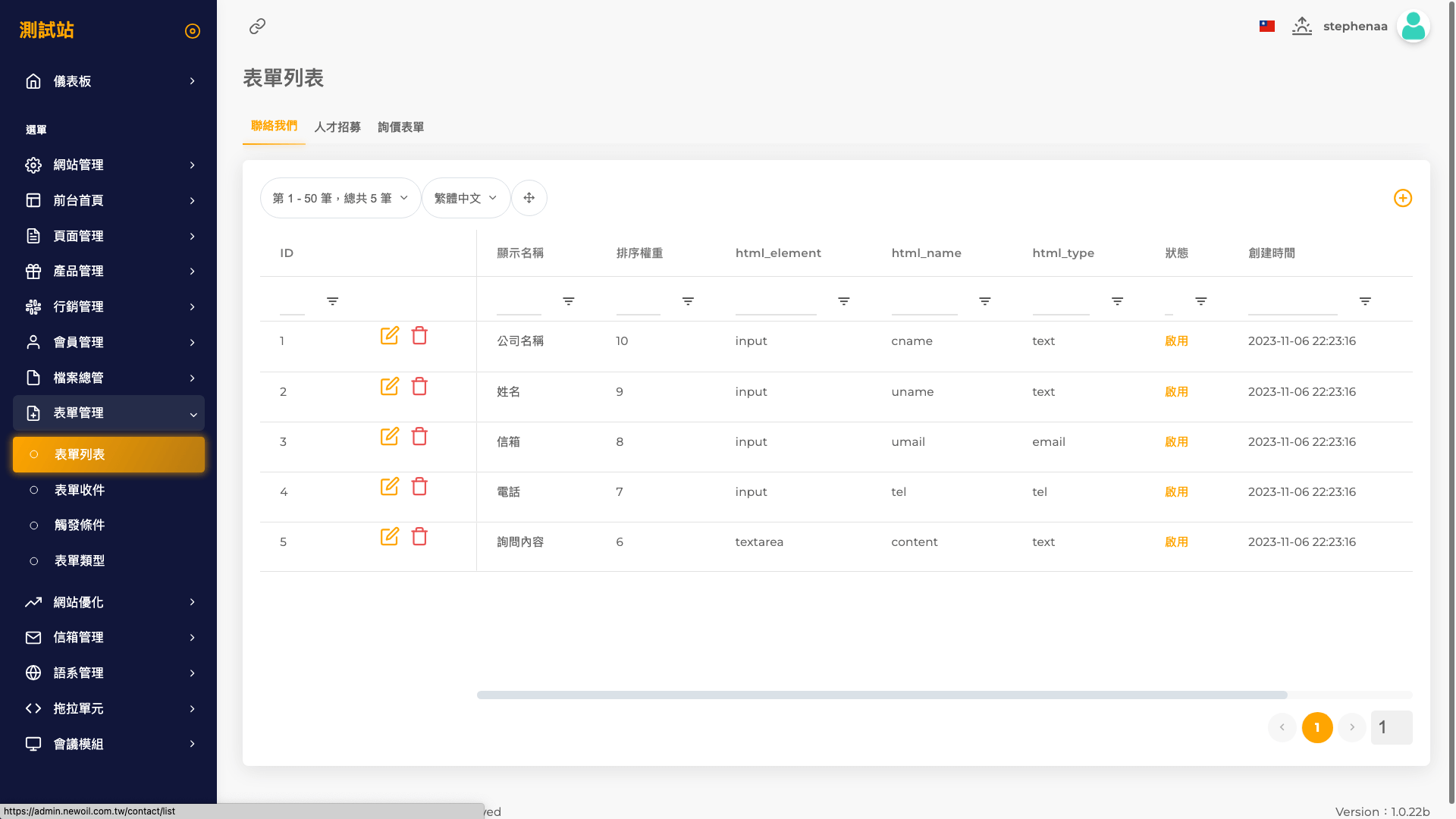
Solution: Dynamic Forms
Using dynamic form creation instead of fixed field design, allowing the same git project to adapt to various different requirements.
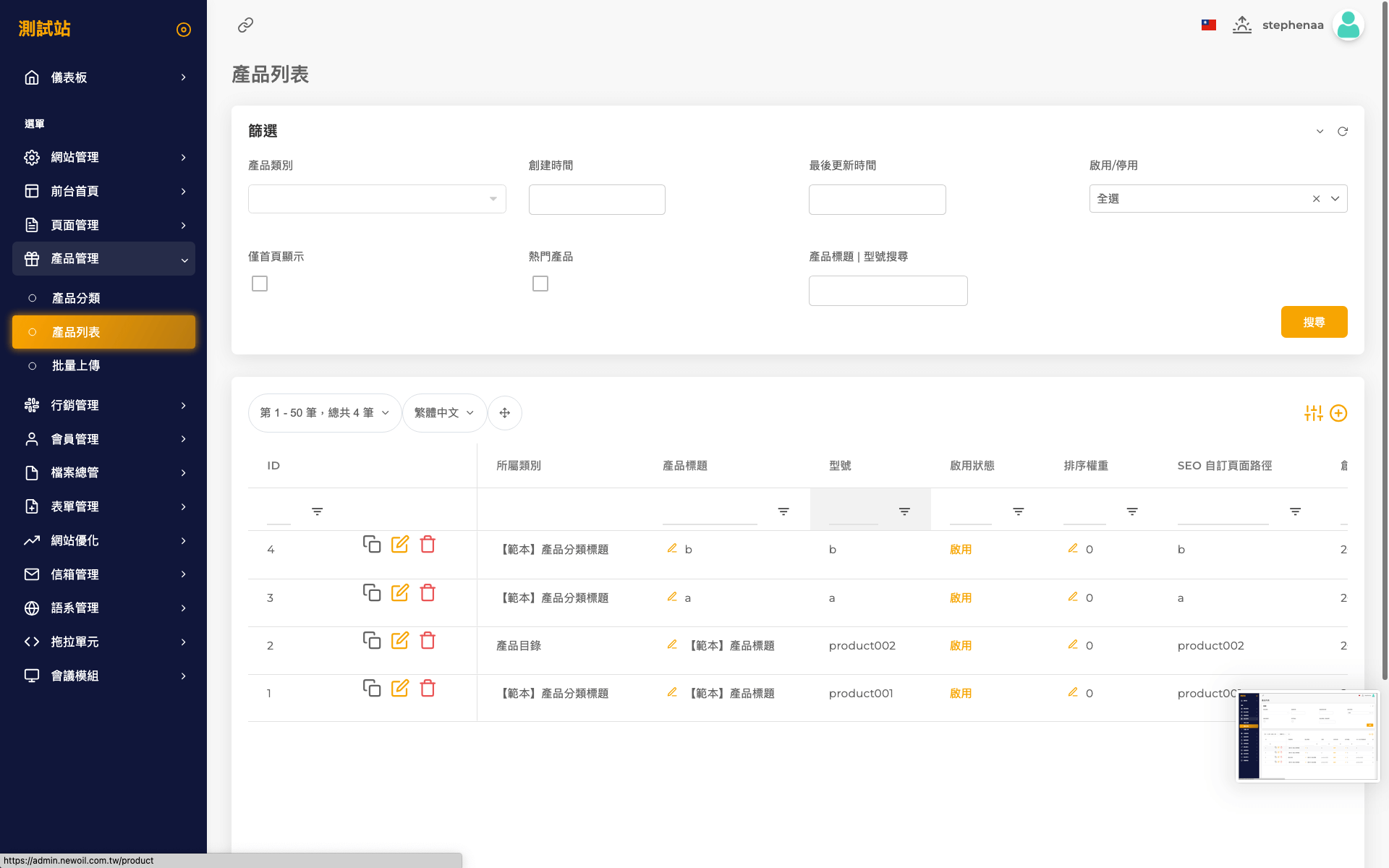
Backend management interface providing intuitive content management features
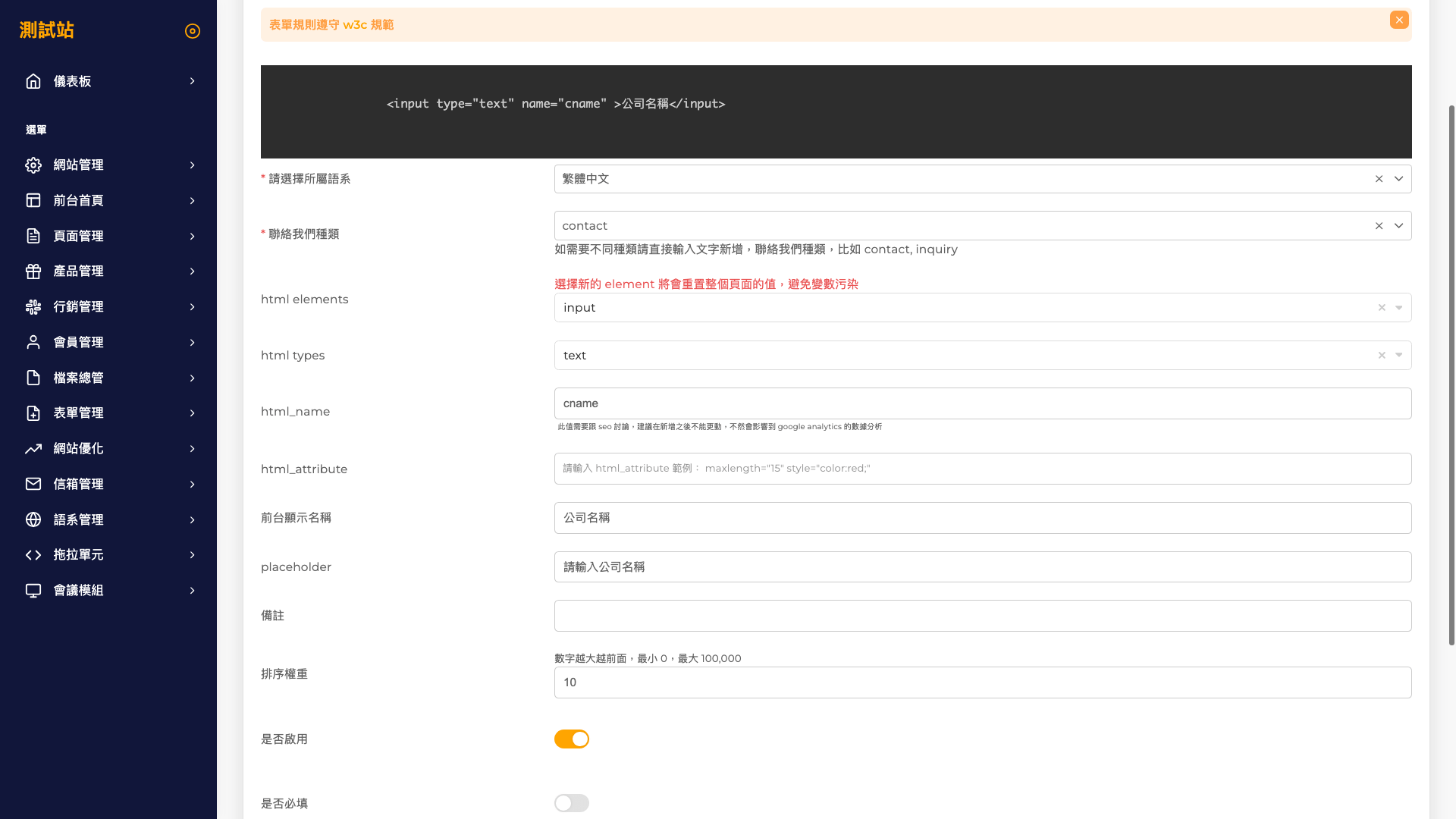
Dynamic form settings allowing flexible configuration of various field combinations
Why Batch Updates Matter
Example 1: Sending Emails
Initially we used Service C, but suddenly one day Service C's account was locked, or the company needs to switch to Service E.
Or the email title was originally You have a new message needs to be changed to You have a new Contact Us message, requiring code changes.
In this company, almost all websites need to send emails. This is where batch updates come in handy. As long as the code is consistent (same git repo) you can update nearly 57 websites in just 10 minutes (real case and number).
Example 2: Article Publishing Time
One day Client D suddenly wanted articles to have publishing time functionality.
Another day Client E suddenly wanted articles to have custom sorting order.
But what if there are more and more clients? Each client having different logic and approaches wouldn't that create high maintenance costs?
So if I can give both Client D and Client E all three fields simultaneously, unifying requirements, wouldn't that greatly reduce maintenance costs?
Just unify to one logic, unify to one git project, and you can achieve easy maintenance.
Perhaps for Client D, the sorting requirement is unnecessary, and for Client E, the publishing time is also unnecessary. But being in an agency company, after weighing the options, I still adopted this approach.
Because in the real world, there aren't just 5 clients, but 60+ clients, and there will only be more clients in the future.
System Features
22 Languages
Backend switch settings supporting global multilingual websites
Role Permission System
Permissions granular to fields, 226 total fine-grained permissions
Unlimited Levels
Multilingual categories, pages, product categories and products with unlimited levels
Member System
Third-party login, approval mechanism, member levels, dynamic registration fields
Form Management
Conditional sending, dynamic form settings, form groups
Marketing Management
Coupon system
SEO Automation
Automated JsonLD generation for each page, one-click publish/unpublish SEO
UI Customization
Theme switching, multilingual banners
System Demo
Technical Implementation
Project Responsibilities
In this system, I'm responsible for Server, Backend, and Admin Panel. Each project is frontend-backend separated.
Technical Foundation of Batch Updates
All client websites use the same git repository, with unified codebase making batch updates possible. When new features need to be added, bugs fixed, or dependencies updated, deployment to all client websites can be done in a short time.
Practice of Abstract Thinking
Through dynamic form creation, dynamic field registration and other techniques, the system can adapt to various different requirements. While this design approach increases initial development complexity, it significantly reduces long-term maintenance costs.
Technologies Used
Backend
- Laravel Framework
- Custom Composer Package
- RESTful API Design
Server
- Laradock (Docker Containerization)
- Redis (Caching System)
- MySQL (Database)
Admin Panel
- Vue2
- vue-router
- vuex (State Management)
- vue-i18n (Internationalization)
- Ag-grid (Table Component)
- Tinymce (Rich Text Editor)
- Filebrowser (File Management)
Monitoring
- Uptime-Kuma (Service Monitoring)
Related Technical Articles
Technical articles accumulated during NEWOIL 3 development:
Laravel Related
- Laravel + Google Form = Fast and Simple Survey System
- Packagist — Creating Your Own Composer Package Through Packagist
- Laravel — Laravel Policy with Pivot Table
- Laravel — Laravel Nova
- Laravel Mail
- Laravel Scout + Meilisearch Search Engine (2)
- Laravel Scout + Meilisearch Search Engine (1)
Database Related
Deployment Related
- Deploy — NGINX Proxy Manager + Cloudflare DNS API to Create SSL Wildcard Certificate
- Deploy — Laravel on Google Cloud Platform
- Deploy — Using Docker with Github Actions to Implement CI/CD (2)
- Certbot wildcard
Cloudflare Related
- Cloudflare — Load Balancing + Geo Steering Configuration
- Cloudflare — Defending Against DDoS Attack + HTTP Flood Attack
Other
Project Highlights
Crystallization of Industry Experience
This system is the result of refinement through 60+ client requirements. Each feature's design considers actual application scenarios, not imagined but generalized from real requirements.
Maintainability First
Although initial development requires more abstract thinking, the unified codebase and batch update mechanism significantly reduce long-term maintenance costs. When there are new requirements, all client websites can be updated synchronously.
Balance Between Flexibility and Standardization
Meeting customization needs through dynamic configuration while maintaining code uniformity. This design philosophy allows the system to handle various different requirements while maintaining good maintainability.