National research institute site · Accessibility & security compliant
2026
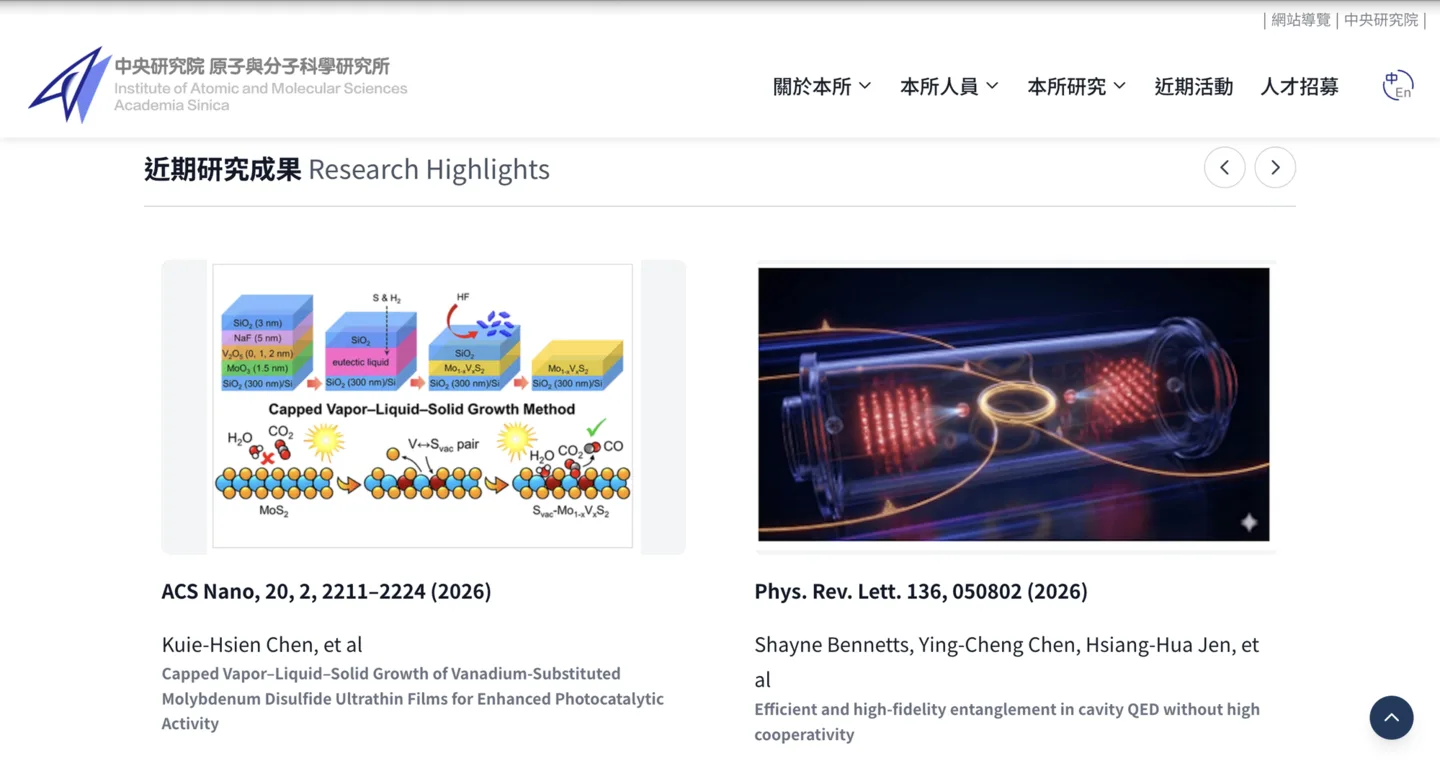
The Institute of Atomic and Molecular Sciences (IAMS), Academia Sinica is a national research institute spanning physics, chemistry, and life sciences. This project rebuilt its public website while meeting government requirements for web accessibility, information security, and on-premise deployment.
The system is built on a custom content-management platform with bilingual support, letting staff independently maintain news, events, research highlights, and recruitment — with Chinese and English managed in a single interface to lower the maintenance barrier.
Delivery uses containerization, packaged into offline installation media and deployed inside an air-gapped internal environment. The site went live after passing accessibility testing and an information-security vulnerability scan.
A Chinese / English admin lets staff maintain both languages from one interface, while the front end switches automatically by locale — eliminating duplicate build and maintenance effort.
News and announcements are managed by category with display dates and automatic publish/unpublish scheduling, so expired items close at the set time without manual intervention.
Manage talks, seminars, and other events with scheduled dates and categories. The front end presents upcoming activities in chronological order to keep the community informed.
Research highlights, journal papers, and academic honors are showcased through image-text cards and carousels, conveying the institute's research output and international impact.
Job openings, researcher recruitment, and graduate-program admissions are managed centrally with clear application information, supporting talent acquisition and international program enrollment.
Designed to government accessibility standards: semantic structure, keyboard operability, skip-to-content, compliant color contrast, and custom accessible error pages — verified by accessibility testing.
Security response headers, access and authentication controls, and ongoing dependency patching. Findings from third-party vulnerability scans were remediated and retested to meet agency security requirements.
The application, queue, and scheduler services are containerized and packaged into offline installation media, enabling deployment inside an air-gapped internal environment.
The admin is a custom content-management system, modeling news, events, research highlights, and recruitment as admin resources, with navigation groups and role-based access tailored to the institute's workflow so non-technical staff can maintain content intuitively.
The front end uses static site generation: content is pre-rendered into pure static HTML for public serving, while the dynamic system and admin are never exposed externally. Only the generated static files run in the public environment, dramatically reducing the attack surface and speeding up load times — a strong fit for government on-premise deployment and security requirements.
The front end uses URL-prefixed locale routing, while the admin maintains Chinese and English fields on the same record, with both content and UI strings driven by i18n. The site renders the correct locale automatically and emits proper language markup for both international and domestic readers.
The entire site follows government accessibility standards: semantic structure, keyboard operability, skip-to-content, compliant color contrast, and custom accessible error pages, with added assistive-technology support for dynamic components — ultimately passing accessibility testing.
Comprehensive security response headers, access and authentication controls, and continuous dependency patching were applied. Before launch, findings from a third-party vulnerability scan were remediated and retested to meet the agency's security standards.
A multi-stage build produces a lean application image, and the application, queue, and scheduler services are orchestrated with container technology. All images and deployment files are packaged into offline installation media for installation, database initialization, and startup inside an air-gapped internal environment.
A scheduler handles automatic publish/unpublish of content; expired news and events close at the set time, paired with clear display-date hints in the admin, keeping front-end information current and reducing manual upkeep.
The public-facing site pre-renders content into pure static HTML; the dynamic system and admin backend are never exposed externally, so only the generated static files run in the public-facing environment. This dramatically shrinks the attack surface and improves load speed — a good fit for government agencies' security testing and internal deployment requirements.
Beyond standard website development, this kind of project requires extra time for accessibility remediation, third-party vulnerability re-scanning, and building and validating the containerized offline installation media. The overall timeline is usually longer than a typical corporate site, and varies with the agency's internal review process and number of testing rounds.
Yes. The modular design of the custom content management backend and the approach to accessibility and security hardening are reusable practices. The containerized packaging with offline installation media can also be adapted to each agency's internal network environment and security requirements, extending to other government or academic institution websites with similar compliance needs.
CONTACT US
Whether it's a government agency, academic unit, or non-profit organization — needing accessibility compliance, security testing, or air-gapped on-premise deployment — we build the right solution to spec.
Contact Us